


I was surprised and delighted to find this session among the myriad session offerings at Urbana 25.
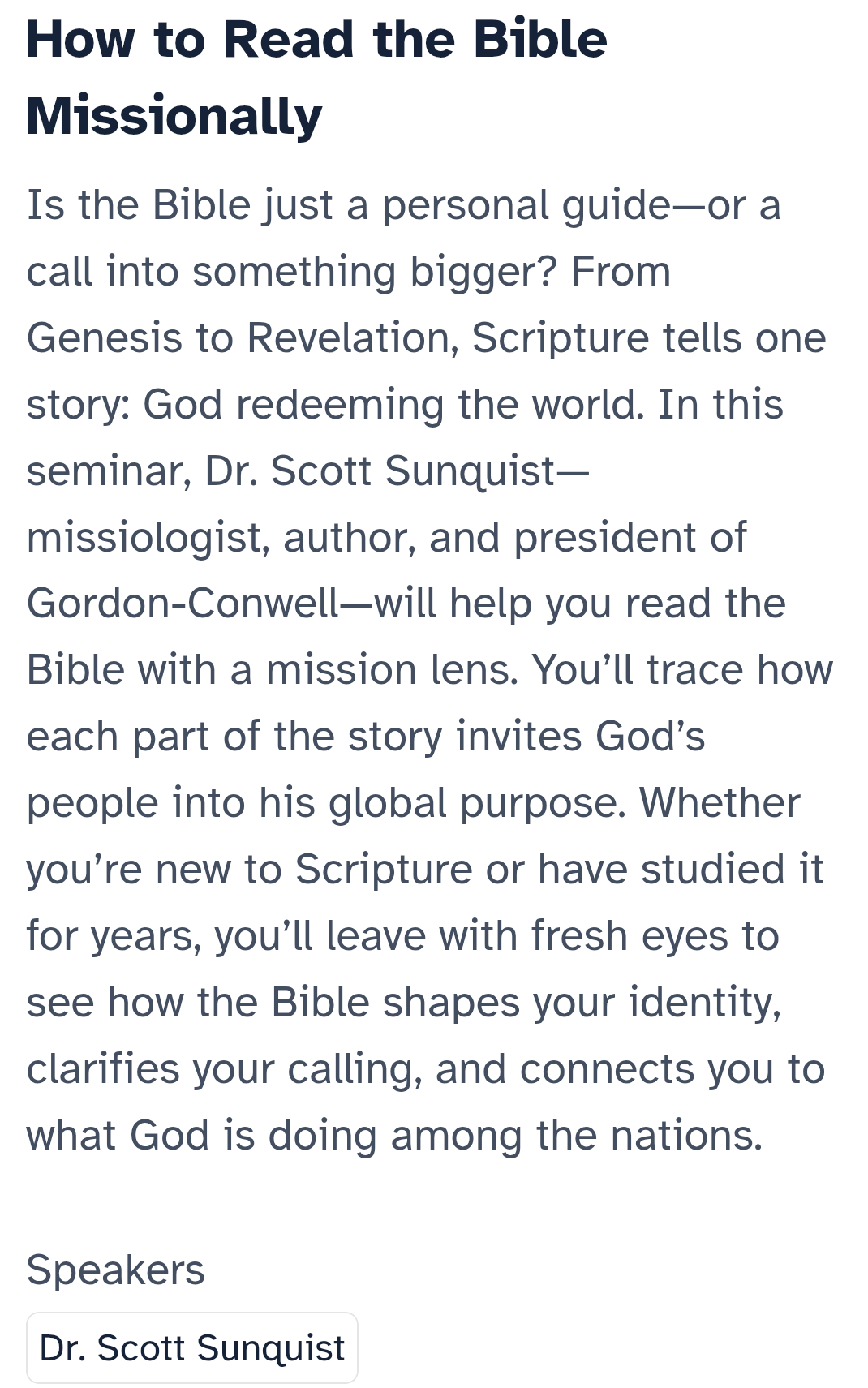
Dr. Sunquist is a missiologist whose work I have long admired. His book Understanding Christian Mission: Participation in Suffering and Glory (2013) is a serious piece of work. So I attended this session with high hopes.
Here’s the thing that might be surprising: missional hermeneutics and missiology have little to do with each other. There have been points of contact along the way, and early on in the development of missional thinking, there were more. But there are few bona fide missiologists in the missional hermeneutics conversation, which is quite postcolonial and, therefore, suspicious of the traditional “missionary” agenda that survives in some Evangelical circles.
To be clear, the missional hermeneutics folks I run with would tell you, I have been saying for years that the perception of traditional “missions” as just an extension of old colonialist (ethnocentric, oppressive, etc.) interests is badly wrong, not only in terms of academic missiology (which has, in many ways, been ahead of progressive Christianity regarding incarnational, culturally adaptive, solidary insights and practices) but also in terms of the on-the-ground commitments and practices of long-term missionaries trained in such missiology. Including the InterVarsity sort of Evangelicals I’m hanging out with this week!
So, it’s a pretty big deal that we’re bringing the Forum on Missional Hermeneutics to the American Society of Missiology annual gathering in 2026. Likewise, Dr. Sunquist’s session here at Urbana 25 might be a sign of the times.
Keep in mind, this is a massive conference. The session offerings are tremendously diverse, and many of them are on urgent, sexy, or intriguing topics. So I had pretty modest expectations about how many twenty-somethings would show up for “How to Read the Bible Missionally.”
It was standing-room only in a big room. I’m guessing a couple of hundred students were crammed in there. In the midst of their exploration of God’s call, these young people are hungry for an understanding of Scripture.
Now, three of the four students I brought from ACU are missions majors at a Christian university where they study a lot of Bible (and the fourth is my daughter, a missionary kid raised by a missionary-theologian). I’ve been tickled to hear them express a desire for more serious biblical interpretation in the keynote addresses. They already have a pretty high bar (shout out ACU DBMM!).
The issue is that Urbana is not really designed for them. Of the thousands of university students in attendance, the vast majority are in other majors at secular universities. They are in the process of discerning their role in God’s mission, and Urbana aims to “mobilize” them. In a sense, it’s a gigantic intro. to missions event. Which means most of the presentations are rudimentary. So it was with “How to Read the Bible Missionally.”
I’m confident Dr. Sunquist thoughtfully contextualized his presentation for this audience. So, although I might have hoped for more evidence of interaction with the missional hermeneutics conversation, I understand why the session had to be very basic.
I won’t recount his presentation in detail since the content is his to share, and he mentioned the intention to write a book on the subject. I hope he does! But here are the essential elements:
John Stott’s presentation at Urbana in the early 1970s in which he asserted that God is a missionary God. And Sunquist adds, the Bible is a missionary text. (It’s important for missional theology folks to recognize how early this claim was being made among Evangelicals. Newbigin’s work at the same time is the point of departure for missional hermeneutics folks. Stott was right there with him.)
A multifaceted rendition of the basic message of the Bible in missionary terms.
A rendition of the basic narrative of the Bible (using the popular “four acts” model) in missionary terms.
An account of four major biblical themes (these were a mix of common ideas, with Richard Bauckham’s Bible and Mission seeming to contribute, and choices that appear particular to Sunquist) in missionary terms.
The conclusion that the Bible is a missionary book for a missionary people.
It’s noteworthy that Sunquist alternated between the adjectives missionary and missional without differentiation throughout his presentation. This is a sticking point in missional theology that will be a significant issue as missional hermeneuts and missiologists increasingly interact, particularly in settings where the traditional “missionary” role is a working assumption. Again, that role is contested even at Urbana, where the controlling ideas are still global evangelism and church growth. I’m excited to see where the conversation goes!
I do think, as you note, it is important to mention just how early this claim of a "missionary God" and a "missionary Bible" was being made among Evangelicals. I'm pretty certain Hartenstein and Barth both use that language regularly. But, for Evangelicals, I'm putting my money on D.T. Niles or George Vicedom, perhaps Blauw.
Greg, I think this really connects with some of the items you talked about with SPBC students. Just defining terms can be so important, as we all often assume we know the meaning, and everyone is on the same page.